
Available In:
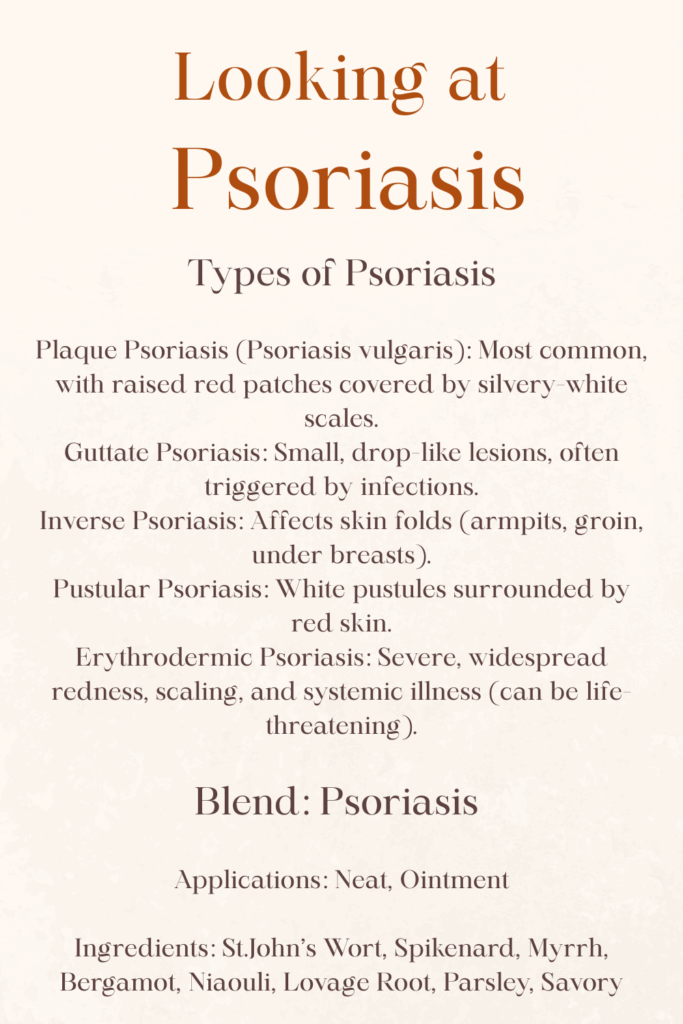
Applications:
Neat, Ointment
Ingredients:
St.John’s Wort, Spikenard, Myrrh, Bergamot, Niaouli, Lovage Root, Parsley, Savory
Psoriasis
1. Definition
- Psoriasis is a chronic autoimmune skin condition.
- It causes rapid skin cell turnover, leading to thickened, scaly patches that can be itchy, painful, or inflamed.
- Unlike eczema, which is largely barrier dysfunction + allergic hypersensitivity, psoriasis is more of an immune-driven overproduction process.
2. Causes & Mechanisms
- Autoimmune Reaction: The immune system mistakenly activates T-cells, which trigger skin cells (keratinocytes) to multiply up to 10× faster than normal.
- Genetic Factors: Strong hereditary link; certain gene variants increase risk.
- Immune Pathways: Overactivation of Th1 and Th17 cells, releasing inflammatory cytokines like TNF-α, IL-17, and IL-23.
- Environmental Triggers: Stress, infections (especially strep throat), cold weather, skin injury (Koebner phenomenon), alcohol, smoking, certain medications.
3. Types of Psoriasis
- Plaque Psoriasis (Psoriasis vulgaris): Most common, with raised red patches covered by silvery-white scales.
- Guttate Psoriasis: Small, drop-like lesions, often triggered by infections.
- Inverse Psoriasis: Affects skin folds (armpits, groin, under breasts).
- Pustular Psoriasis: White pustules surrounded by red skin.
- Erythrodermic Psoriasis: Severe, widespread redness, scaling, and systemic illness (can be life-threatening).
4. Symptoms
- Raised red patches with thick, silvery scale.
- Itching, burning, or soreness.
- Nail changes (pitting, ridging, separation from nail bed).
- Psoriatic arthritis (joint pain, stiffness, swelling) in up to 30% of patients.